Friday, February 29, 2008

Iditarod 2008


I was introduced to the Iditarod when we were homeschooling. I"m hooked. I am not a dog lover, but the race fascinates me. The race begins tomorrow morning (Saturday March 1) at 10 am with the 'restart' on Sunday. The race follows the northern route since it is an even year. The race covers over 1000 miles with the finish line in Nome.

I found a Lutheran connection. The Teacher on the Trail is a Lutheran school teacher. Jane Blaile is from Christ Lutheran School in sunny Phoenix, Arizona.

I'll be keeping track of the following racers:

Ed Stielstra who is from Michigan and a veteran racer.

DeeDee Jonrowe who is from Alaska and a veteran racer.

Jeff King who lives in Alaska and is one of the favorites to win.

God's blessings on all the racers and their teams.

Spirituality of the Cross -- The Paradoxes of Lutheranism

Notes from Chapter 2

Paradoxes of Lutheranism
  • Lutherans tend to be highly conscious of sin, without falling into moralism.

  • Lutherans treasure theology and have a rich intellectual tradition, while emphasizing the limits of speculative reason.

  • Lutherans are skeptical of mystical emotionalism, but they cultivate an intense inner piety and a worship centered in in effacable mysteries.

  • The Christian, according to Luther, is simul justus et peccator -- at the same time righteous and sinner.

  • The Christian is totally free, yet a slave -- in Christian service -- to everyone.

Thursday, February 28, 2008

Spirituality of the Cross -- Law and Gospel

Crucifixion (Città di Castello Altarpiece)
Raffaello, 1502-03
Notes on Chapter 2
Justification
Law and Gospel
  • "There is no one righteous, not even one [so much for moralism!]; there is no one who understands [so much for speculation!]; no one who seeks God [so much for mysticism!] Romans 3:12
  • A genuine confrontation with God's Law destroys complacency, security, and every shred of self-righteousness.
  • For Lutherans, God's Law has many 'uses' -- to restrain evil in society; to serve as a guide for Christians; to cut through our layers of self-deception so that we realize just how lost we really are. In biblical language, the Law brings with it the 'conviction of sin', inspiring 'repentance'.
  • The Law is the prelude to the Gospel. Those broken by the Law are convinced of their need and of their inability to save themselves. Then the message that God does it all comes as an astounding relief, as good news.
  • Faith itself is considered by Lutherans to be a gift of God, created in the human heart as His action through the Holy Spirit. Properly speaking, it is Christ on the cross who saves. Faith is simply dependence on that sacrifice.
  • The pattern of conversion is repeated every Sunday, in the confession and absolution, in the pastor's sermon which is always a proclamation of Law and Gospel.
  • He [Luther] said that we should be broken by the Law and animated by the Gospel every day: "The old Adam in us, together with all sins and evil lusts, should be drowned by daily sorrow and repentance and be put to death."
  • Those who have been justified by Christ are changed from the inside. Good works flow unconsciously from the work of Christ.
  • Christians, however, have a double nature -- indwelling Christ [Luther's new man] and the old sinful nature from Adam ["the old Adam"]. These are in constant conflict.
  • The disciplines of prayer, confession, and the ministry of Word and Sacrament, enable the Christian to grow in holiness and good works -- a process known as sanctification.
  • There is a dynamic oscillation between lows and highs, knowledge of sin and knowledge of forgiveness, repentance and assurance. The Gospel is to predominate.

Tuesday, February 26, 2008

Spirituality of the Cross -- Justification

Notes on Chapter 2
Justification
The Dynamics of Sin and Grace

  • Instead of insisting the human being attain perfection, Lutheran spirituality begins by facing up to imperfection. We cannot perfect our conduct, try as we might. We cannot understand God through our own intellects. We cannot become one with God.
  • We do not have to ascend to God; rather, the good news is that He has descended to us. Lutherans insist that there is nothing we can do, but that God does literally everything.
  • Human sin and God's grace are the two poles of Lutheran spirituality. They are resolved in the principle by which, it is said, the church stands or falls; justification by grace through faith.

Paths to God

  • Moralism -- seeks to earn God's favor, or a satisfying life, through the achievement of moral perfection. Good people go to heaven, it is thought, while bad people go to hell.
  • Speculation -- the assumption that knowledge is the key to spiritual fulfillment. Many answers have been offered, but they keep changing, as the history of human thought shows. One school of philosophy is succeeded by another, and even scientific theories keep having to be revised.
  • Mysticism -- attaining the ecstatic experience of becoming one with God. The techniques of achieving such experiences are varied, from ascetic self-denial to elaborate methodologies of mediation, but they all promise spiritual ecstasy and supernatural empowerment.
  • Lutheran spirituality begins with the insight that all human efforts to reach God are futile. God is the one who is active, not human beings. The issue is not our ascent to God, but God's descent to us.
Lutheran spirituality is all about what God does. To rescue us from our miserable and depraved human condition, He became a human being Himself. The God-man Jesus Christ accomplished the perfection moralists only aspire to and took upon Himself the punishment for everyone's moral failures by dying on the cross. The spiritual life has to do with recognizing God's work -- what He accomplished on the cross and what He continues to accomplish in people's lives through the Holy Spirit.

Monday, February 25, 2008

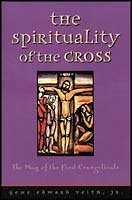
The Spirituality of the Cross

This is Lent and a time to reflect on your faith. There are many ways to do that. Three years ago I read The Spirituality of the Cross, The Way of the First Evangelical by Dr. Gene Veith. I have re-read the book 4 times since. It is a short book, as books on theology go, and easy for the average person to read. Dr. Veith is a layman -- not a theologian or a pastor. The book is free of technical language. I have underlined, highlighted and filled a notebook with notes.

The table of contents reads:

Introduction: The First Evangelical
Justification: The Dynamics of Sin and Grace
The Means of Grace: The Presence of God
Theology of the Cross: The Hiddenness of God
Vocation: The Spirituality of Ordinary Life
Living in Two Kingdoms: The Sacred and the Secular
Conclusion: Worshiping God

Some notes from the first chapter:

  • The term "evangelical" is simply a term derived from the Greek word for "Gospel", which in turn literally means "good news." "Evangelical" means someone who focuses on the Gospel of Jesus, the good news that Christ, through His death and resurrection, has won forgiveness of sinful human beings and offers salvation as a free gift.....the word "evangelical" meant Lutheran.
  • They (Lutheran) were also the first to emphasize the Gospel to such an extent that it became central to every level of their doctrine and practice.
  • The fact is, there can be no spirituality without theology, no religious experience apart from religious belief.
  • One of the strengths of the Lutheran tradition is that theology is taken seriously and has been thoroughly worked out.
There is a study guide available for download through the Concordia Publishing House.

Thursday, February 14, 2008

Hearing God's Voice

Hearing God's voice -- What does that mean?

We had a Service of Light/Evening Prayer for Wednesday night service as it is Lent. Pastor gave a message which was so clear and simple. He used the message that he had shared with the children at chapel earlier in the day. His message talked about Calvin and Hobbs and how much fun it is to have imaginary friends you can talk to. But he also talked about our friend Jesus and specifically how we talk to Him and how He talks back to us.

The message was simple -- one way we talk to Jesus is in our prayers and Jesus answers back in his Word. His Word may shape the thoughts that we have and the dreams we dream, but the clear response back from Him is always in Word and Sacrament.

Wednesday, February 13, 2008

On Changing Churches

The one thing in life that is constant is change and one of the hard things for me is to change churches. I have always been a faithful member of a church. I haven't changed churches often, but when I have it's been hard and for good reason.

The one constant is, I have always been and will always be a Lutheran. Faith was created in me by the Holy Spirit when I was only a 2 month old infant and my parents had me baptized at Lookout Lutheran Church in Gilmanton, Wisconsin. Throughout my life I have been sustained by the means of grace -- namely Word and Sacrament. That's one of the treasures of being a Lutheran.

In 2000 I found it necessary to make the biggest church change in my life -- I left the church that I grew up in and that my family attends. It was an ELCA (Evangelical Lutheran Church in America) church and I made the synod jump to the LCMS(Lutheran Church Missouri Synod) that was across town. Not a great way to win a popularity contest with your family -- but that was not what the change was all about. It was an opportunity for me to more fully explore what being Lutheran means. What I discovered in that process was that there are some fundamental differences between the ELCA and the LCMS. And those differences mattered to me.

When we made the jump across synods we also made a leap into a new worship style. We attended a large LCMS church which uses a praise and worship style for worship. The words to the music and anything that needed to be said as a congregation is projected on large screens. The service begins with a medley of songs (praise songs as well as hymns). The music is led by a worship team which might be a few people or many. There might be only a pianist or a large group of musicians. The traditional liturgy is not used, however aspects of it are included. Like many Lutheran churches, communion is not given weekly, but twice a month. The messages are usually a series on a topic that covers multiple weeks. The church calendar is not evident in terms of colors and I don't think the lectionary is used to determine readings and prayers.

Now it's 2008 and I've found it is necessary to make another change. Our 7 years in that particular church were filled with blessings and many friends. We have been feeling a desire to return to a smaller Lutheran church with liturgy and weekly communion. I feel that I've returned home in some regards as we are transferring back to a traditional Lutheran church. But in the last 7 years I have fully embraced the LCMS and I now understand liturgy in all its richness.

The comfort I take in all this over the years is that:

The grass withers and the flowers fall, but the word of our God stands forever.
Isaiah 40:8

For, "All men are like grass, and all their glory is like the flowers of the field; the grass withers and the flowers fall, but the word of the Lord stands forever." And this is the word that was preached to you.

1 Peter 24-25